Boosting yields for climate friendly Robusta coffee in Tanzania develoPPP Project

Project Background
Climate-friendly Robusta coffee production reduces GHG emissions and strengthens climate resilience of smallholder producers.
Project Overview
Project title::Climate-friendly Robusta coffee production reduces GHG emissions and strengthens climate resilience of smallholder producers.
Project objective: To reduce GHG emissions from the production of Robusta coffee by smallholder farmers and processors in Tanzania within the JDE Peet’s supply chain:
- Measuring and assessing the carbon footprint of coffee production.
- Identifying core impact factors and potential for improvement.
- Implementing mitigation strategies (including GHG emissions in- and off-setting).
- Supporting market uptake of climate friendly coffee and with this.
- Creating positive socio-environmental benefits for the farmers and local communities of the coffee sector in Tanzania and beyond.
Project Management: 4C Services GmbH
Project financed by: The develoPPP Project* is financed by DEG Impulse with public funds of the German Federal Ministry for Economic Cooperation and Development (BMZ), together with funds of JDE Peet’s.
More information about develoPPP Program
develoPPP is a funding programme of the German Federal Ministry for Economic Cooperation and Development (BMZ). It promotes private-sector activities where entrepreneurial opportunities and development policy potential meet. Companies that want to invest sustainably in a developing and emerging country and expand their local operations can receive financial and technical support under the programme. The financing and implementation of a develoPPP project is carried out jointly with one of the two experienced public implementing partners: DEG Impulse GmbH or Deutsche Gesellschaft für Internationale Zusammenarbeit (GIZ) GmbH.
More information about JDE Peet´s
The project partner JDE Peet’s is the world’s leading pure-play coffee and tea company, serving approximately 4,500 cups of coffee or tea per second. JDE Peet’s sources coffee from diverse coffee growing areas, processes the beans, and sells coffee in more than 100 countries with a portfolio of over 50 brands. Tanzania is an important coffee origin and coffee growing supports the livelihoods of many smallholder farmers. Our Common Grounds programme carries out long term farmer initiatives to increase sustainable coffee production, regenerative agriculture and improve the livelihoods of smallholder coffee farmers. As part of the company’s global sustainability targets and as a result of this project, JDE Peet’s will be sourcing climate friendly coffee free from deforestation and with limited carbon emissions from Tanzania.
Implementing partners:
Touton S.A., Karagwe District Cooperative Union, 4C Services, Meo Carbon Solutions and GRAS Global Risk Assessment Services.

More information about Karagwe District Cooperative Union (KDCU LTD)
Karagwe District Cooperative Union Limited (KDCU LTD) is a Coffee Cooperative Organization located in North-West Tanzania, within Kagera region. It is a wholly farmer-owned cooperative organization with a membership of over 64,330 peasant coffee farmers, represented by 123 primary cooperative societies from across Karagwe and Kyerwa districts. KDCU aims at increasing coffee production and quality to enhance coffee farmers’ incomes and livelihoods.
KDCU Ltd is also vital in providing crop finance, transport, processing, grading, packaging and marketing its members’ coffees. The Union has an annual output of approximately 32,000MT of green coffee comprised of Robusta (97.5%) and Arabica (2.5%) varieties. Over 90% of the Union’s coffees are sold on the Tanzania Coffee Board national auction, and about 7% to specialty markets primarily in Germany, Japan, USA, Italy and Netherlands.
More information about Touton
Forging a strong link between thousands of coffee producers and worldwide roasters, Touton is the global green coffee trader offering ambitious, responsible, and tailor-made services. Building on 15 years of experience, we offer all ranges of green coffee, Robusta, and Arabica, of which we master both the qualities and the complexities of supply chains. Through our vast and reliable network of partners and offices in Africa, Asia, and Latin America, we bring a unique and comprehensive expertise for innovative market intelligence, financial, logistics and sustainability services to meet our clients’ needs, with the highest degree of flexibility. Touton Group’s sustainability model of shared value creation is at the core of our coffee sourcing strategies. Beyond certification, we co-create with clients and growers, targeted and evolving sustainability programs to bring transformational change. Touton is also engaged in collective action through sectoral platforms such as the European Coffee Federation, the Global Coffee Platform and Sustainable Coffee Challenge.
More information about Meo Carbon solutions
Meo Carbon Solutions is an independent consulting company with longstanding experience in sustainability. They are active in Europe, South-East Asia, Africa, and the Americas and they manage projects for public and private sector clients. Meo’s projects regularly involve the participation of stakeholders from industry, agriculture, NGOs, research institutions and public authorities. Within the scope of the develoPPP project, Meo performed a baseline greenhouse gas (GHG) emission calculation covering the coffee supply chain in Tanzania, followed by the support of the implementation of emission reduction activities and the monitoring of future emission levels. Meo’s analysis covers activities such as cultivation, processing, storage, transportation, and distribution of coffee to the final client.
More information about Global Risk Assessment Services
GRAS is a comprehensive solution to implement and monitor sustainable and deforestation-free supply chains by the verification of compliance of relevant sustainability criteria using the latest remote sensing technologies. GRAS supports crop-specific mapping, quantification, and assessment of risks from deforestation, grassland conversion, and other environmental parameters, such as fire, water shortage, drought, and erosion, from the field to the country level.
GRAS conducted a detailed Land Use Change Assessment for the project, through a semi-automated analysis based on remote-sensing technology. GRAS uses current and historic satellite images and EVI Enhanced Vegetation Index time series to detect and verify actual land-use change activities as well as to identify potential GHG emissions due to deforestation or conversion of other high carbon stock areas.
Project period: 08/2021 – 01/2024
Key Results
Enhanced coffee farmers’ knowledge on GHG emissions and their capacity to implement emission reduction measures and good agricultural practices:
- Development of dedicated training curriculum adapted to local context.
- 20 field officers and 40 lead farmers trained as multipliers to disseminate knowledge among the farmers.
- 44 demonstration plots established as key learning centres to showcase results of adopting sustainable practices.
- More than 8000 farmers have been trained on topics such as climate change and coffee production, good agricultural and climate smart practices, record keeping, water management on the farm, pruning of coffee plants, plant nutrition and soil health, and shade management and agroforestry practices.
- Nursery establishment with more than 320,000 shade trees of the species Macadamia, Mango, Avocado and Mihumula distributed to farmers for better shade management and possibilities for income diversification.
GHG emissions calculation from production and processing of Robusta coffee:
- Development of a transparent and updatable GHG calculator and digital data collection system.
- Data collection from more than 100 coffee farms, 13 Agricultural Marketing Cooperative Societies (AMCOS) and the dry mill to establish a base and endline on GHG emissions.
- 22% reduction of GHG emissions in 2024 compared to the baseline from 2021.
- First, 4C Carbon Footprint Add-on Certificate issued to KDCU supporting market uptake of their climate-friendly coffee.
As the world seeks solutions to face the reality of climate change, the importance of mitigating the effects of greenhouse gas (GHG) emissions becomes increasingly significant. Coffee production and its value chain rank highly in GHG emissions, yet it simultaneously plays a key role in sustaining millions of livelihoods around the world. Tanzania is no exception. The total GHG emissions from Tanzania in 2014 were 286.49 million metric tons of carbon dioxide equivalent (MtCO2e), totalling 0.59% of global GHG emissions. Of these emissions, land-use change and the forestry sector account for 72.7% followed by agriculture, contributing 17.3% (Climate links, 2014).
These GHG emissions are however expected to increase with intensified natural forest conversion for agricultural cropland.


The project region, Kagera, in the northwest of Tanzania, already bears evidence of these developments. The region lost 34.5 kHa of tree cover between 2001 and 2019, which is equivalent to almost 6 Mt of CO2 emissions. Research projects have identified specific GHG emissions hotspots in the Tanzanian coffee supply chain that need to be addressed with efficient reduction measures.
With this project, 4C and its implementation partners are helping to bridge the gap by facilitating a better understanding of the different drivers of emissions. Based on this, appropriate reduction and off-setting measures are identified and adopted along the supply chain. The project activities include the sensitization of farmers on climate-smart agriculture and the need to protect soil carbon.
Project Measures
1. Measuring GHG Emissions
Measuring initial GHG emissions is the first crucial step to understand and quantify the negative environmental impact of coffee production in the project region. To allow for an adequate baseline measurement of GHG emissions, a joint workshop with the project partners was held to map JDE Peet’s coffee supply chain in the region and define the system boundaries.
Based on the mapping results, Meo Carbon Solutions conducted an in-depth analysis to develop a customized data collection template with the support of KDCU, the local coffee cooperative and Touton, the international supply chain manager.
Data was then collected from 126 coffee farmers and 13 Agricultural Marketing Cooperative Societies (AMCOS) as well as the dry mill of the local implementing partner KDCU. For the assurance of a representative sample of the farms, the whole group was clustered along the annual yield and area of the farm and sampled farms were selected from the four resulting clusters.
More Information
The baseline data collection was complemented by the work of Global Risk Assessment Services (GRAS) who conducted a land use change analysis to determine the potential deforestation risk areas within the project region. In addition, soil samples were collected from the 126 sampled coffee farms to determine the baseline soil organic carbon content.
Following the data collection process, Meo Carbon Solutions developed a customized GHG emission calculator based on the methodology of the 4C Carbon Footprint Add-on, considering recognized standards and initiatives such as ISO 14067:2018, GHG Protocol Product Standard, PAS 2050:2011 and IPCC guidelines. Further the Carbon Footprint Add-on is aligned with the guide from the Science Based Target Initiative (SBTi) and the Paris Agreement. With the baseline data and the developed GHG calculator, the total amount of GHG emissions for the coffee production from cultivation to the dry mill were calculated in kg Co2 equivalent per ton of green coffee.
The data collection process was repeated twice during the project, once in 2023 and again in 2024 for the endline. Each cycle showed significant improvements in data accuracy due to increased enumerator experience and the refined and targeted training programs.
To further develop the GHG reduction strategy, identifying the sources of emissions on each of the different levels in the supply chain was key. At the farm level the primary emission drivers were identified as the use of fertilizers and transportation. For the AMCOS level also transportation played a crucial role alongside with plastic consumption. This is also true for the dry mill level, where also energy consumption contributes to the GHG emissions.

2. Identifying and implementing GHG reduction and carbon stock accumulation measures
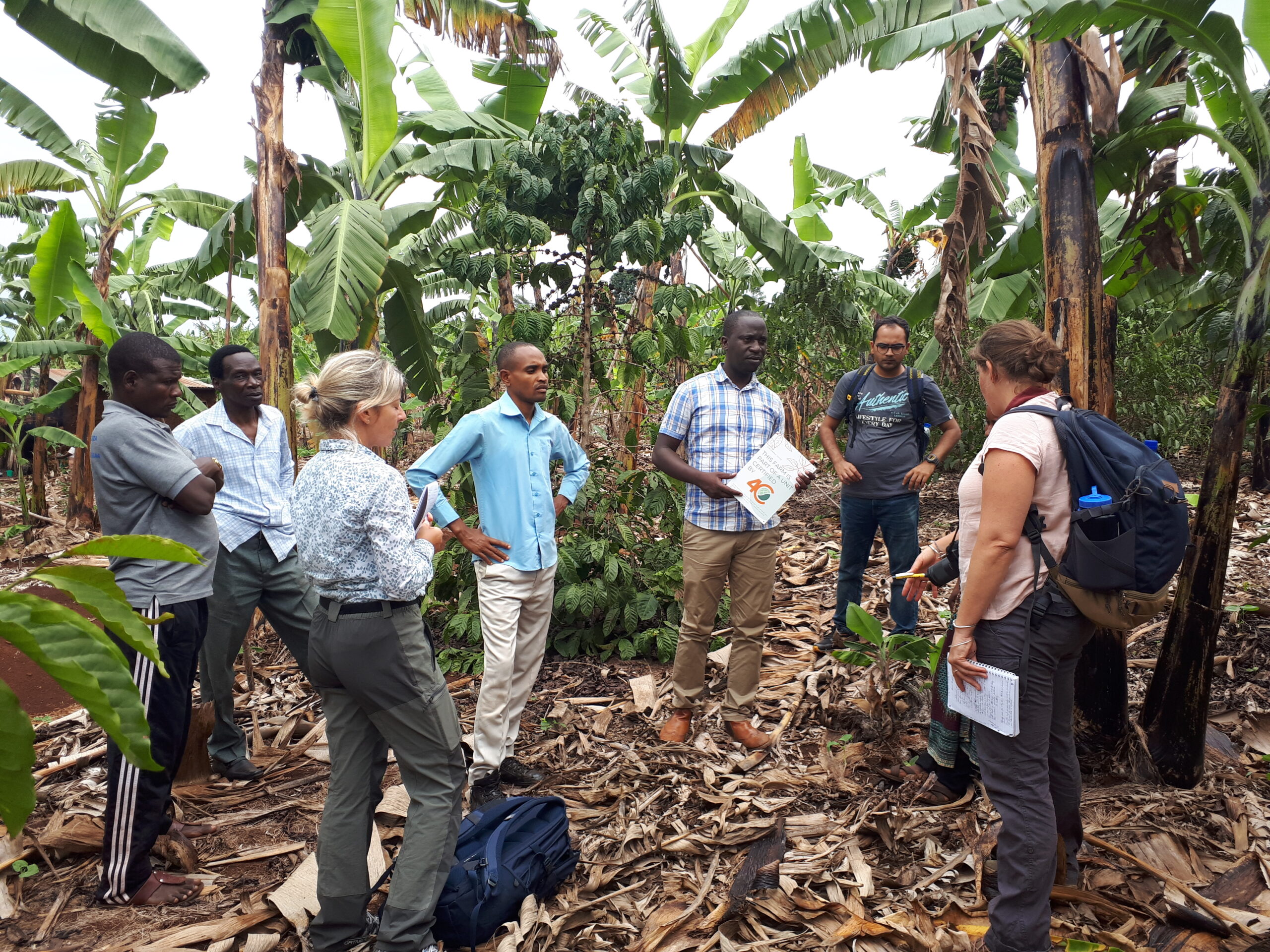
The results from the baseline data collection and GHG emission calculation supported the identification of potential emission reduction strategies as well as in-setting opportunities. 4C, Meo Carbon Solutions, JDE Peet’s, Touton and KDCU worked very closely together to identify suitable measures and to provide technical and financial support to farmers to implement the identified measures. The focus of the reduction measures was being put on improving cultivation through good agricultural practices with the aim of improving soil quality and increasing yields.
To strengthen the capacity building, a training curriculum tailored to the context of the project region has been developed to support farmers in the implementation of climate-smart agricultural practices.

The training material was tested in the field and feedback from trainers and target groups has been integrated into the final training material. For the purpose of the trainings and dissemination of knowledge to farmers, demonstration plots have been established where recommended measures are being applied and shown with the respective results to farmer groups. Training sessions with farmers started in the beginning of 2023 and lasted until the end of the project in November 2024. To allow for direct practical implementation, the training sessions were aligned with the coffee calendar, teaching each topic during the time of the year when it is relevant to be implemented by the farmers.
To support additional emission reduction and carbon removals within the supply chain, as part of the project, a nursery for shade tree seedlings was set up. In this nursery, seedlings for macadamia, mango, avocado and other local shade trees were grown and handed out to the farmers participating in the project. The seedlings will grow into shade trees and support farmers in creating an optimal climate on their coffee farm, besides storing carbon and providing additional income opportunities to the farmer’s household through the sale of the fruits.
As the emissions identified in the analysed supply chain are comparably low, the possibility for carbon offsetting options to enable reasonable compensation for unavoidable GHG emissions was explored, though due to project constraints not further pursued.
3. Market uptake of climate friendly coffee in Europe
4C has developed a Carbon Footprint Add-On to be used on top of our core standard. The farmer groups participating in this project in the Kagera region were among the first 4C users implementing this new feature. The 4C Unit obtained their 4C Climate Friendly certification in September 2022. A clear system boundary was set to facilitate the calculation of GHG emissions. The baseline GHG calculation, the annual updates for the maintenance of the certificate, and the monitoring of emissions in the framework of the project significantly contributed to the development of the 4C Carbon Footprint Add-On by providing learnings from the ground, related to sampling procedures, data quality and recording of inputs.
Awareness-raising campaigns are being conducted to distinguish coffee with reduced GHG footprint and the 4C Climate Friendly label is increasing its market uptake in Europe. The long-term viability and continuous market uptake of Climate Friendly green coffee from the project region will be ensured through credible high-level sustainability certification, marketing and communication campaigns and the development of local and international partnerships.


4. Dissemination of Project results 4C sustainability project in East Africa
The project results have been disseminated within the project region and beyond through multistakeholder workshops with relevant actors from Tanzania and neighbouring countries. After testing the developed training curriculum on climate-smart coffee production in the context of the project, it was handed over to the local implementing partner KDCU, cooperating with more than 130 AMCOS in the region, together gathering almost 65,000 farmers, to provide for continuous knowledge sharing. Beyond Tanzania, project results were shared on several events online as well as in-person with stakeholders interested in the 4C Carbon Footprint Add-on and GHG emission calculations and reduction measures.
4C Sustainability Project in East Africa

Discover the Project in Pictures!

Further Information