Our Services
Compliance Services
Navigating a Changing Regulatory Landscape
The regulatory environment for agriculture is evolving rapidly. Laws such as the EU Deforestation Regulation (EUDR) and emerging Human Rights Due Diligence (HRDD) frameworks are raising expectations for traceability, transparency, and accountability across global supply chains.
For both companies and producers, this means ensuring compliance is not only about meeting legal requirements but also about maintaining market access, protecting reputation, and strengthening resilience.
4C provides tailored compliance solutions that combine certification, Add-Ons, innovative technology, and training. These services prepare producers, traders, roasters, and retailers alike to navigate regulatory change and demonstrate sustainability leadership.
Our Focus Areas
EU Deforestation Regulation
Ensure compliance with EUDR’s deforestation-free requirements
The EU Deforestation Regulation requires companies to prove that their products are deforestation-free and legally produced. 4C supports system users with a comprehensive EUDR solution that includes traceability via the 4C Portal, remote sensing technology through our partnership with GRAS, and a complete due diligence system to help companies meet these new requirements.

Human Rights Due Diligence
Implement policies and practices to identify, prevent, and address human rights risks
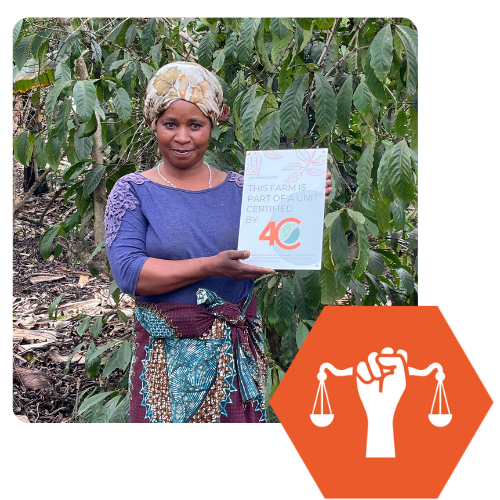
Human rights compliance is becoming a core expectation across global supply chains. With the Food Security Add On and enhanced auditing approaches, 4C helps companies implement effective HRDD, addressing key risks such as labour rights, food security, and working conditions. This ensures alignment with international frameworks and emerging regulations.
German Supply Chain Act
Lieferkettensorgfaltspflichtengesetz – LkSG
The German Supply Chain Due Diligence Act (Lieferkettensorgfaltspflichtengesetz – LkSG) requires companies to identify, prevent, and address risks related to human rights and environmental standards in their global supply chains. 4C provides a credible and practical tool to support companies in meeting LkSG requirements.


ESG and 4C’s Approach
ESG stands for environmental, social and governance. It helps companies understand and report how their operations and supply chains affect people and the environment, as well as how their organisations are managed.
As expectations for transparency grow, companies need reliable supplier data that can support reporting without creating duplicate processes.
4C is developing a pilot that uses verified certification and supplier data to create standardised, ESG-aligned reporting outputs for coffee and cocoa supply chains. The work draws on a comparison between 4C certification requirements and EFRAG’s Voluntary Sustainability Reporting Standard for SMEs, which identified significant overlap.
- Verified at source: 4C audit reports already confirm essential procedures on the ground.
- Connected to reporting requirements: the 4C system and its audits already cover key ESG topics.
- Less duplicate reporting: verified audit information can be combined with selected quantitative metrics instead of being collected again through a separate process.
- Useful outputs: the planned reports are intended to support customer communication, internal management and regulatory compliance.
Partner with 4C on the pilot
4C is inviting buyers, roasters, traders and certified managing entities to take part in the pilot. Partners will help ensure that the reporting outputs work for real supply chains and respond to practical reporting needs.
- Set the priorities: identify the ESG indicators that matter most to your organisation and test the report templates against your needs.
- Access the approach early: be among the first to work with the pilot’s ESG reporting model.
- Reduce repeated work: explore how data already collected and verified through 4C audits can support your reporting.
Interested in taking part? Contact the 4C technical team to discuss how your organisation can contribute.

Further Information