Improving biodiversity in coffee landscapes in Vietnam Environmental Scope


Project Background
Improve biodiversity in coffee production by setting up and implementing biodiversity action plans on a landscape level.
Project Overview
Project title: Improving biodiversity in coffee landscapes in Vietnam.
Project objective: The overall aim of the project is to improve biodiversity in coffee production by setting up and implementing biodiversity action plans on a landscape level, using the Biodiversity Performance Tool (BPT) adapted to the local context of the region in which it is applied.
Project Management: 4C Services GmbH.
Project financed by: 4C Services GmbH.
Advising partners: Lake Constance Foundation and Fundación Humedales.
Implementing partners: Vinh Hiep Co. Ltd. and Agriculture and Forestry Research & Development Center for Mountainous Region (ADC).
About 4C
4C is a leading sustainability certification scheme for the entire coffee sector that includes economic, social and environmental requirements to establish credible sustainable and transparent supply chains. 4C’s credibility is based on independent 3rd party audits, innovative risk assessments and a strong integrity programme. With more than 300,000 farmers and 1.7 million tonnes of certified coffee, 4C delivers real impact on the ground, improving livelihoods and supporting companies in their sustainability goals.
About Lake Constance Foundation
The Lake Constance Foundation is a private organisation for environmental protection and nature conservation in Germany. The project-oriented foundation works towards more sustainability and nature protection in the international Lake Constance area and beyond. The working areas are: Agriculture and Climate, Business and Biodiversity, Energy Transition, Nature and Lake Conservation.
About Agriculture and Forestry Research & Development Center for Mountainous Region (ADC)
Agriculture and Forestry Research & Development Center for Mountainous Region (ADC) is a research and technology transfer organization working for the sustainable development of the people in the mountainous provinces of Vietnam. ADC is operating in various fields such as: agriculture, forestry, biodiversity, animal husbandry and fisheries development, natural resources management and conservation, socioeconomic development, poverty alleviation and policy advocacy and climate change.
About Vinh Hiep Co. ltd
Vinh Hiep was established in 1999 working in the field of manufacturing, purchasing, processing and exporting coffee-pepper-roasted coffee. Vinh Hiep together with its supplying farms is certified under the 4C certification standard since 2013. Currently, Vinh Hiep manages around 1,400 – 4C certified farmers with a total area of 3,200 ha. After 20 years of operation in the field of purchasing and processing agricultural products, annual export of coffee and pepper reached 70,000 tons, export turnover reached over $ 150 million.
About Fundación Humedales
Fundación Humedales is a Colombian NGO founded in 2000, with the purpose of contributing to the conservation and management of aquatic ecosystems, based on an integral human and environmental approach. In compliance with this purpose, they develop projects on conservation, and participatory management of natural resources, environmental education programs, improvement of productive practices and on strengthening community associations while at the same time developing strategies of inclusion of gender and minority groups to scientific research.
Project period: 01/2021 – 05/2022
Key Results
updated August 2022.
Significant changes in coffee farms after 1 year.
Application of good management and farming practices:
- Intercropping with fruit trees or other perennial crops, breaking monoculture system.
- Increased vegetative layers to cover soil surface.
- Maintaining and planting flowers/shrubs to protect beneficial insects, pollinators and bringing nicer view on the coffee farms.
- Shade tree maintenance and growing more shade trees.
- Other good farming practices widely implemented.
- Not only coffee farm but surrounding area is also protected.
Awareness Raising and Capacity Building:
- Practical skills to establish the micro-ecosystem of coffee farms, eliminate bad practices and risks of decreasing biodiversity performance.
- Integrated Pest Management (IPM) and Weed Management (IWM), incorporation of plants that attract beneficial insects and pollinators.
- Promotion of shade trees and intercropping.
Awareness raising and Capacity building activities have been conducted by local partners to equip farmers with practical skills on how to identify micro ecosystem of their coffee farms, recognize bad practices and risks having negative effects on biodiversity. Farmers are guided on Integrated Pest Management (IPM) and Weed Management (WM) where many rush/flowers good for beneficial insects and pollinators are planted. In addition, field support provided has helped farmers to be confident in replant their coffee farms where shade trees and intercropping is significantly promoted.
Potential Impacts:
- Session of biodiversity is integrated in the training on 4C requirements to all farmers who joined Vinh Hiep’s sustainable coffee production chain. Key focus is what is the importance of biodiversity, how farming practices can protect biodiversity and coffee trees are more resilient to climate change?
- Adjacent farms are invited to the training of piloted farmers, and additional 1000 farmers are the potential target of expansion of the Vinh Hiep’s activity, to form sub-groups of farmers mutually supporting each other.
Further potential impacts at larger scales through the continuous implementation of improvement measures by farmers, and replication of good practices by the local partner, Vinh Hiep company, to their farmers.
Baseline Study
Up to one million plant and animal species face extinction due to increasing deforestation rates, climate change, pollution and other human activities.
According to a report published by the Intergovernmental Science-Policy Platform on Biodiversity and Ecosystem Services (IPBES) in May 2019, nature is declining globally at rates unprecedented in human history. Up to one million plant and animal species face extinction due to increasing deforestation rates, climate change, pollution and other human activities. The report showcases, that the loss of biodiversity is one of the biggest challenges of our time. Intensive agriculture is considered as one of the main drivers of the destruction of ecosystems, overexploitation of natural resources and contamination. Looking into coffee production, it is grown in some of the world’s biodiversity “hotspots”, which are areas of high vulnerability and biological importance.
More Information

Vietnam is the second-largest coffee exporter after Brazil, having expanded its area for Robusta coffee production from 15,000 ha in the mid-1980s to 600,000 ha in 2017/2018. The environmental footprint associated with this expansion and the intensification of Robusta coffee production is very significant. Especially the Central Highland region is marked by intensive monoculture plantations and intensive irrigation and fertilizer use which resulted in problems of soil degradation and pollution, destruction of groundwater, and pest infestation. Approximately 15% of Vietnam’s species are considered endangered and much of Vietnam’s biodiversity loss is linked to the loss of natural forest cover.
Improving biodiversity performance on coffee farms not only serves nature protection, but is also the basis for sustainable, successful, and climate change resilient coffee production. Awareness of agriculture-driven biodiversity loss is increasing in European markets, and companies are increasingly committing to more action on biodiversity. However, many projects and approaches are focused on singular topics, such as pesticide use or shade trees. What is missing is a holistic approach to biodiversity, accompanied by a pragmatic approach of demonstrating progress, which can be efficiently monitored and transparently communicated along the supply chain.


Projects Measures
The Biodiversity Performance Tool (BPT) developed by the EU LIFE Initiative “Food & Biodiversity” is a tool to fill this gap. It is a practical instrument to realize a baseline evaluation of the situation of biodiversity on the farm, makes visible strengths and weaknesses using a classification system of thresholds, and generates a Biodiversity Action Plan based on the baseline evaluation for two lines of action such as the creation of potential for biodiversity and the reduction of negative impacts on biodiversity. It supports farmers or farm group managers to decide which measures to implement to improve biodiversity on the ground and allows transparent communication on the actual progress made.
The BPT has been adopted to the Vietnamese context and applied on different 4C certified farms to evaluate the biodiversity situation and set up and implement biodiversity action plans.
Phase 1 – Adaptation of the BPT to the Vietnamese context and testing of its implementation
Phase 2 – Upscaling through the elaboration and implementation of Biodiversity Action Plan(s) (BAP) on a landscape level
Phase 3 – Support of market access
Phase 4 – Dissemination and anchoring of results
ADC has adopted the BPT to the Vietnamese context and used it during their farm visits in January 2021 to conduct a baseline evaluation and identify the potential for biodiversity improvement.

In compliance with the restrictions due to the pandemic, field visits to the beneficiaries’ farms began in July 2021, led by the project four field officers, who are experienced agronomists from the region. During the farm visits, the field officers provided coffee farmers with the technical assistance they need to implement best management practices. In addition, impact measurement was an important part of the project, during the farm visits the project field officers were using an application developed by GRAS to collect the baseline data of the selected beneficiaries and in this way an assessment of change over the timeframe of the project was possible.
The field visits also served to identify best practice farms to serve as farmer field schools and training plots. The selected demonstration plots belong to farmers who have shown improved environmental and social conditions in their farms, promote sustainable coffee production and sourcing, and integrate sustainability into coffee production.
Due to the COVID-19 pandemic restrictions, in-person group trainings have not been allowed in 2021. However, coffee growers have showed their readiness for increased digital trainings. Trainings have been conducted online and had a very positive respond. Furthermore, dialogue through Whatsapp groups has increased, and the platform has allowed coffee growers to stay connected among them and with the project field officers. Seven Whatsapp groups were set up with coffee farmers in the communities of Cienaga, Santa Marta, Fundacion and Aracataca, providing them with information about the project, e.g. videos, posters, invitations to workshops and answers to their questions.
Once restrictions were lifted at the beginning of 2022, the envisaged group trainings could start with a focus on good agricultural and climate smart practices in sustainable coffee production and additionally tackling topics on entrepreneurship skills and the 4C certification. Until the end of the project in April 2023 more than 100 group trainings took place. Specific group trainings focussing on best practices were conducted on the selected demonstration farms.
In addition, in March 2022 trainings dedicated to the young adults could start. Trainings provided during the project were: coffee and tourism, webpage development, coffee tasting and business and value chain mapping.
he trainings to the project beneficiaries lasted until the end of the project in April 2023. The training concept, approach and content used during the project lifetime is documented in a Training Handbook which was presented at the final workshop of the project with the aim of disseminating the results.
To enable the implementation of the learnings from the training, the project supported coffee growers and young adults from Magdalena with the contribution of material goods such as agrochemical warehouses, protective equipment sets, coffee tasting sets and post-harvest quality sets.
Expected Project Results
Invaluable benefits for farmers in terms of training, acquiring support and know-how on developing biodiversity action plans and in-kind support for implementing improvement measures
- Improved coffee farming practices that support conservation of biodiversity and lead to better productivity and greater profitability for farmers.
- More biodiverse coffee regions due to the implementation of biodiversity-friendly coffee production on various farms.
- Increased awareness at local, regional, and national level on the benefits of biodiversity conservation within coffee plantations.
- Improved market links between coffee farmers producing biodiversity-friendly coffee and responsible markets in Europe.

Testimonials
Voices from the Field
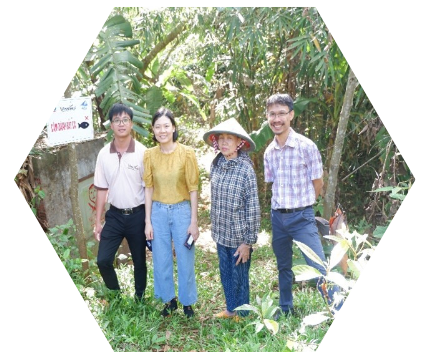
“Since our certification, we have said no to herbicides and reduced the use of pesticides to the minimum… now our coffee farm is more diverse than” ever
Dang thin Xuan Farmer
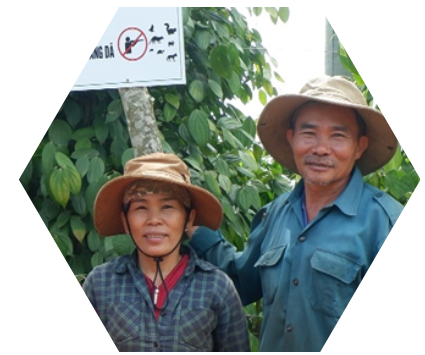
“More bees, and butterflies come to our coffee garden, so the fruiting rate is also higher than before, and we obtain other products from trees, vegetables and herbs for our family.”
Phan Dinh Tu Farmer
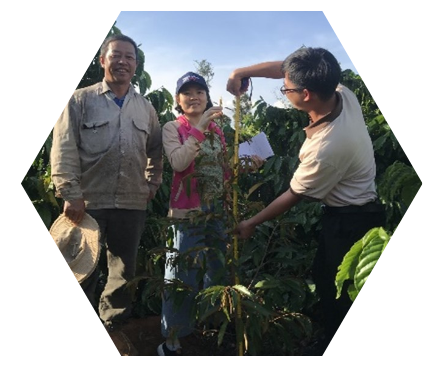
“We have learned about the value of biodiversity and how to enhance it! our soil is now looser and more fertile, coffee plants are more resilient, and beneficial insects such as ladybugs, bees, worms and crickets have reappeared…”
Le Van Ha Farmer
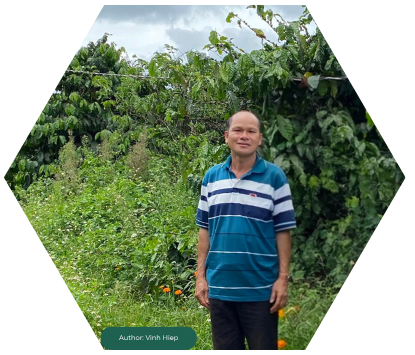
“Pruning and composting require more effort than using chemical fertilizers or herbicides, but the results are worth it! My coffee trees are stronger and making my own microbial compost will save me about 20 million VND this 2022 in chemical purchases.”
Nguyen Anh Vu Farmer

Discover our others Projects!

Further Information